
Restore Teeth Compromised by Decay
 When a tooth has more damage than a filling can handle but does not yet need a full crown, there is a middle option that many patients never hear about: dental inlays and onlays. These tooth-colored restorations offer the strength and precision of a lab-fabricated restoration while preserving more of your natural tooth structure than a crown would require. At the Edward J. Ambis Center for Dental Medicine, Dr. Edward Ambis offers porcelain inlays and onlays to patients in Ithaca, NY, who want durable, conservative care for damaged back teeth.
Interested in a natural-looking, long-lasting restoration for a damaged tooth? Call our Ithaca dental office at 607-272-1874 to schedule a consultation. We welcome patients from Lansing, Dryden, Trumansburg, and throughout the greater Ithaca area.
Why Ithaca Patients Choose Dr. Ambis for Restorations
Restorative dentistry is about more than fixing a tooth. It is about making sure the repaired tooth serves you well for years to come. Ithaca dentist Dr. Edward J. Ambis brings more than 40 years of clinical experience to every restoration, along with a genuine commitment to staying current with advances in dental care. As a member of the American Dental Association and a fellow at the Resnik Institute, Dr. Ambis holds himself to a high standard of care at every appointment.
The Edward J. Ambis Center for Dental Medicine is not a large dental chain. It is a neighborhood practice, located on a quiet residential street in Ithaca, NY, where patients are treated like people rather than appointments. When you come to us for an inlay, an onlay, or any other restorative procedure, you will see familiar faces and receive honest, clear explanations of your treatment options. Patients from Lansing, Dryden, Trumansburg, and across the Finger Lakes region have trusted this practice for decades because Dr. Ambis and his team treat every restoration as if it matters. After all, it does.
What Are Dental Inlays and Onlays?
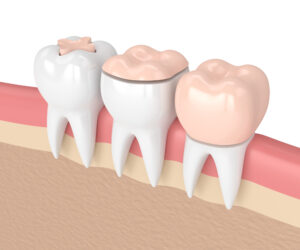
Inlays and onlays are indirect restorations, meaning they are fabricated outside of the mouth in a dental laboratory before being permanently bonded to the tooth. This is different from a traditional dental filling, which is placed and shaped directly in the mouth during a single visit. Because inlays and onlays are precision-made to fit the exact dimensions of your prepared tooth, they offer a significantly stronger, longer-lasting result for moderate to large areas of damage.
They are most commonly made from porcelain, though some are fabricated in composite resin or gold. Porcelain inlays and onlays are particularly popular because they are tooth-colored, highly durable, and stain-resistant. They bond tightly to the tooth structure, which also helps reinforce the remaining natural tooth.
Inlays vs. Onlays: Understanding the Difference
The terms inlay and onlay refer to the location and extent of coverage on the tooth:
- Inlays fit within the cusps of a back tooth, restoring only the central chewing surface. Think of an inlay as a precisely fitted piece that fills in the interior of the tooth without covering the raised points around the edges.
- Onlays extend beyond the inner surface to cover one or more of the cusps, or raised points, of the tooth. They are sometimes called partial crowns because they cover more of the tooth than an inlay but still leave a significant portion of natural structure intact.
Dr. Ambis will recommend the appropriate type based on the size and location of the damage. Both options preserve healthy tooth structure and provide a reliable, long-lasting result.
When Are Inlays and Onlays the Right Choice?
Inlays and onlays occupy the space between a traditional filling and a full dental crown, and they are the right call in specific situations. Dr. Ambis may recommend an inlay or onlay when:
- A cavity is too large for a traditional filling, but does not justify removing enough tooth structure for a crown
- An old silver amalgam filling has cracked, weakened, or failed, and needs to be replaced with something stronger
- A tooth has fractured or cracked in a way that compromises its structural integrity, but the damage has not spread to the full circumference of the tooth
- A patient wants a tooth-colored replacement for old metal fillings in the back teeth
- A tooth is at an elevated risk of fracturing due to existing damage and needs reinforcement before things worsen
In many cases, choosing an inlay or onlay early can prevent the need for a full crown later. That makes it both a clinically sound and cost-effective decision when the situation calls for it.
The Inlay and Onlay Procedure at the Edward J. Ambis Center for Dental Medicine
Getting an inlay or onlay at our Ithaca, NY, dental office typically takes two appointments.
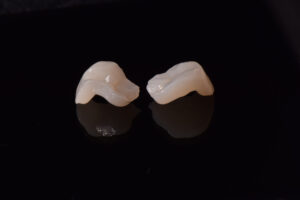 First Appointment
The tooth is numbed with local anesthesia for your comfort. Dr. Ambis carefully removes any decayed or damaged tooth structure, along with any old failing restorations. The tooth is then shaped to receive the inlay or onlay, and impressions are taken and sent to a dental laboratory. A temporary restoration is placed to protect the tooth while your permanent piece is being fabricated.
Second Appointment
 The temporary restoration is removed, and the custom-made inlay or onlay is checked for fit, bite, and color. Any adjustments are made, and the restoration is permanently bonded to the tooth. The bonded surface is polished so it functions and feels completely natural.
Most patients are surprised at how comfortable the entire process is. The local anesthesia keeps both appointments pain-free, and the final result fits so precisely that it rarely requires any significant adjustment period.
Benefits of Porcelain Inlays and Onlays
Choosing a porcelain inlay or onlay over other restoration options comes with several practical advantages.
- Preserves natural tooth structure: Less healthy enamel is removed compared to a crown, keeping more of your original tooth intact.
- Superior strength: Lab-fabricated porcelain is harder and more durable than direct composite fillings placed chairside.
- Natural appearance: Porcelain closely mimics the light-reflecting properties of natural enamel, making the restoration virtually invisible in the mouth.
- Excellent fit: Precision fabrication means fewer gaps where bacteria can accumulate over time.
- Longevity: Porcelain inlays and onlays commonly last 10 to 30 years with proper care and regular checkups.
- Stain resistance: Porcelain does not discolor over time, the way composite resin can.
- Strengthens the tooth: The bonding process can add structural support to a weakened tooth, reducing the risk of future fracture.
Ready to restore a damaged tooth with a lasting, natural-looking solution? Call the Edward J. Ambis Center for Dental Medicine in Ithaca, NY, at 607-272-1874. Our team is here to help.